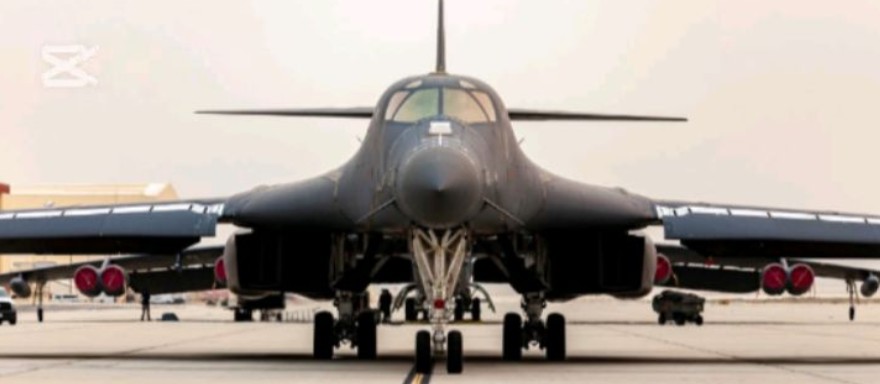
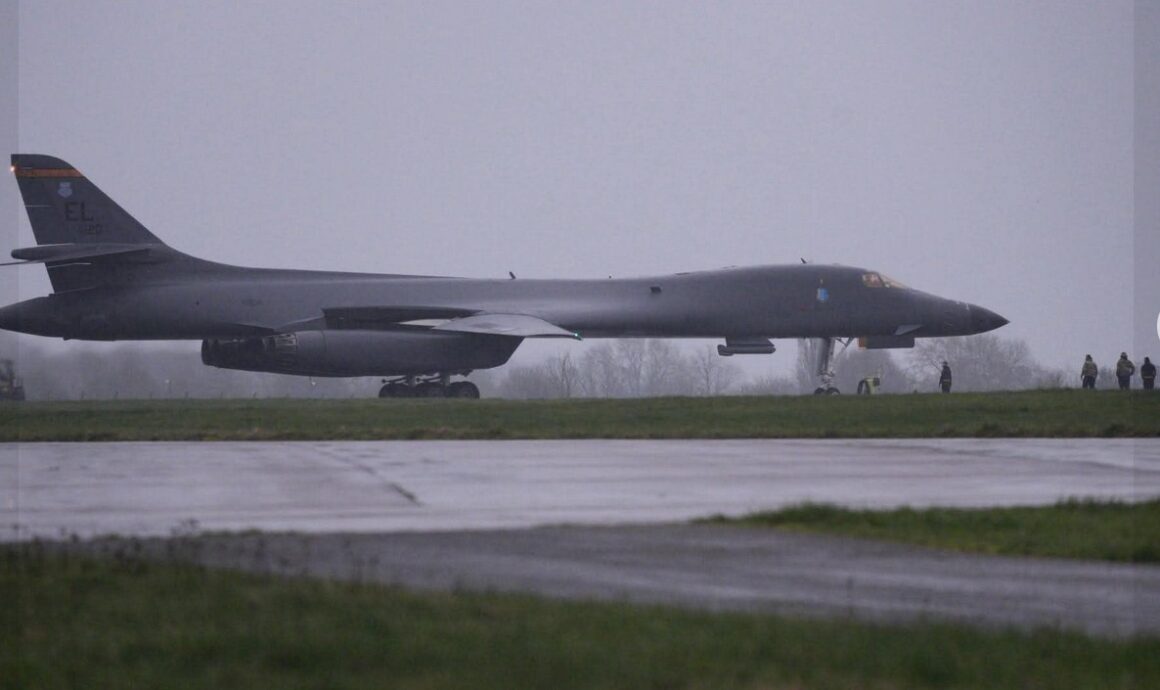
Some of you may have heard that one of the U.S. Air Force’s deadliest jets has arrived in the UK as #DonaldTrump prepares fresh strïkes on Iran.
That jet is called the Rockwell B‑1B Lancer — a legendary long-range bomber that has earned a fearsome reputation on the battlefield.
Nicknamed “The Bone” (from B-One), the B-1B Lancer is one of the most powerful bombers ever built. Designed during the Cold War, this aircraft combines high speed, heavy firepower, and advanced technology to strike targets anywhere in the world.

At first glance, the B-1B is enormous. The bomber measures 146 feet long, with a wingspan of about 137 feet when its wings are extended. One of its most unique features is its variable-sweep wings. The wings can move forward for better lift during takeoff and landing, and sweep backward when flying fast. This design allows the aircraft to fly extremely fast while remaining stable at low altitude.
Powering the aircraft are four powerful afterburning turbofan engines, giving the bomber a top speed of over 900 mph (about Mach 1.2). This makes it the fastest bomber currently in service with the U.S. Air Force. When flying low and fast, the B-1B becomes extremely difficult for enemy radar systems to detect.
Inside the cockpit, the aircraft is operated by a crew of four:
1=Pilot
2=Co-pilot
3=Offensive systems officer
4=Defensive systems officer
Together they manage the aircraft, weapons, navigation systems, and electronic warfare equipment.
But the real power of the B-1B Lancer lies in its massive weapons capacity. The bomber can carry up to 34 tonnes of weapons, one of the largest payloads of any bomber in the world.
Inside its three internal weapons bays, the aircraft can carry:Cruise missiles,Precision-guided bombs,Smart JDAM bombs,Cluster munitions,Conventional gravity bombs.
In some strike configurations, the aircraft can carry up to 24 cruise missiles, making it capable of destroying multiple targets in a single mission.
One of the deep secrets behind the B-1B’s effectiveness is its low radar signature. Although it is not a full stealth aircraft like the Lockheed Martin F‑35 Lightning II or the Northrop B‑2 Spirit, the B-1B was redesigned to reduce its radar cross-section, allowing it to penetrate defended airspace more easily than older bombers.
The aircraft is also equipped with advanced electronic warfare systems that help protect it during combat. These include:
Radar warning receivers that detect enemy radar locks
Powerful electronic jammers that can confuse air-defense systems
Decoy systems that can mislead incoming missiles
Advanced terrain-following radar that allows the bomber to fly extremely low to avoid detection
Another little-known capability of the B-1B is its ability to perform long endurance missions. With aerial refueling, the bomber can stay in the air for many hours and strike targets thousands of kilometers away.
Over the years, the B-1B Lancer has been deployed in many major conflicts. It has played a major role in military operations in:
Syria
Libya
Afghanistan
Iraq
In several operations, the aircraft delivered some of the largest conventional bomb loads ever dropped by a U.S. bomber.
Even though it was originally designed to carry nuclear weapons during the Cold War, the B-1B was later converted into a conventional-only strike bomber, focusing on precision attacks against ground targets.
Today, the United States Air Force continues to rely on the B-1B Lancer as one of its most powerful long-range strike platforms. With its speed, massive payload, electronic warfare systems, and long-range strike capability, the B-1B remains one of the most feared bombers in modern warfare.