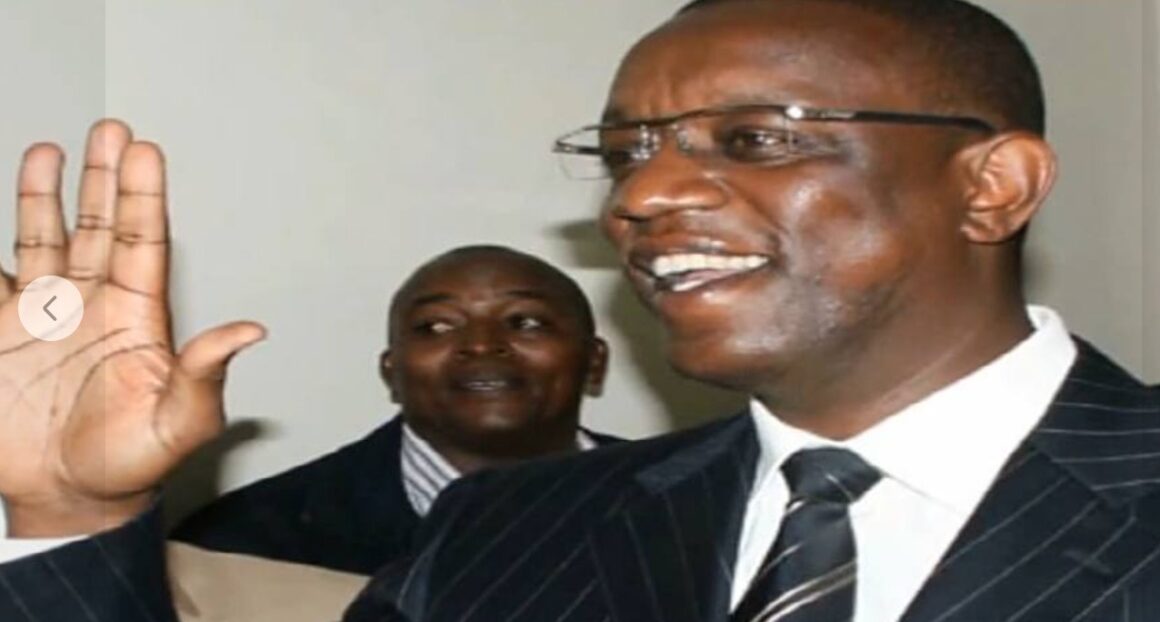
In November 2013, George walked into Club Porkies as a man who had survived corporate boardrooms and electoral courts. He ordered two harmless, respectable beers a modest ambition for a Sunday evening.

He was not a reckless man. He was a former Member of Parliament, a businessman, and a man who understood balance sheets, ballot boxes, numbers, and timing. What he did not understand, however, was chemistry.
Within two hours, the warmth began. Not the warmth of alcohol, but a heat that climbed the spine like an accusation. He complained that he felt unusually hot unbearably so.
He removed his vest in the owner’s office, not out of scandal, but out of survival. Ten minutes later, he was on the floor. The men who had laughed with him now stood over him.
By midnight, George Thuo was dead.

And Kenya, being Kenya, immediately split into two professions: mourners and analysts. The poison was identified as Karate, a pesticide so efficient it does not believe in suspense. It entered and concluded its work without leaving any time to negotiate with doctors.
It is not the kind of substance one consumes hours earlier; it is fast. The science was unromantic about it. This meant the fatal moment had likely occurred at that table, with those men.
George had entered the world on February 14th, Valentine’s Day, 1967. From early on, he displayed the sort of intelligence teachers admire. In 1989, he joined Strathmore College to chase his accountancy certification.
By 1998, he was the Managing Director of Kenya Bus Services. Critics later whispered that he mismanaged the company into debt, and by 2003, the board had relieved him of his duties. But he simply founded City Hopper Limited instead. Nairobi commuters climbed aboard his buses daily, never knowing they were boarding the ambition of a man who refused to exit quietly.
Then came politics. In 2007, he contested the Juja parliamentary seat on a PNU ticket and defeated William Kabogo of NARC-Kenya. The country, meanwhile, tasted smoke. When Mwai Kibaki was declared the winner of the presidential election, Kenya descended into a violence that historians still narrate with lowered voices. Over 1,200 people died and 350,000 were displaced. Politicians spoke in statements, while Kenyans spoke in screams.
Names floated upward, including Uhuru Kenyatta and William Ruto. As the International Criminal Court prepared its files, a power-sharing agreement between Kibaki and Raila Odinga formed the Grand Coalition Government. Peace was negotiated like a business merger. George became the Chief Whip for PNU.
He was inside the machinery now, and the machinery does not always protect its parts. His 2007 victory was nullified in April 2010 by Justice Luka Kimaru over ballot irregularities. William Kabogo reclaimed Juja in the subsequent by-election, and George returned to business. But proximity to power is not something one easily resigns from.
And then came the International Criminal Court. He was reportedly scheduled to testify not for a stranger, but a close friend…Uhuru Kenyatta.
In Kenya, friendship in politics is a flexible instrument. It bends under pressure and snaps under prosecution.
Somewhere in the quiet corners of Thika, Clubs still opens their doors in the evening. Beer is poured, men laugh, and politics is discussed but no one removes their vest lightly anymore.
History dragged George toward The Hague without ever buying him a plane ticket.
The ICC had opened files with names such as Uhuru Kenyatta, William Ruto, Francis Muthaura, Joshua Sang, Hussein Ali, and Henry Kosgey; their crimes were against humanity. And somewhere in those documents, George’s name hovered not as an accused in shackles, but as something more delicate and more dangerous: a witness.
A friend of Uhuru Kenyatta, he was expected to testify for the defense. He was to be an important voice that would declare the violence in Nakuru and Naivasha was a spontaneous, organic, and unfortunate combustion of an angry nation.
But a lady by the name of Fatou Bensouda had her own version of events that read like choreography: that on Sunday, 27th January 2008, George attended a meeting at the Blue Post Hotel in Thika, a property allegedly owned by the Kenyatta family. Thirty members of the Mungiki sect were present.
Her narrative was not shy. It alleged planning, retaliation, and coordination, and went ahead to describe George as the vital link between the sect and state power. Payments were allegedly channeled and transport allegedly organized using his City Hopper buses. Promises allegedly made were that Maina Njenga would be freed, attackers would be compensated, and the government would stop killing their members.
Whether they were the truth, exaggeration, or fiction became the subject of legal duels thousands of miles away in the witness stand. But what mattered was that these documents existed. And they cast a long shadow. George was a man positioned uncomfortably close to the fire.
Away from court filings and whispered conspiracies, George was described as jovial and a lover of Formula One ,a high-stakes sport where speed is celebrated and crashes are televised. He loved his wife, Judy, and his three children. He laughed easily.
Those who saw him in private insist he enjoyed life with a great appetite, which makes the following days cruel in their ordinariness. On Wednesday, 13th November 2013, he returned from India, landing at Jomo Kenyatta International Airport. He expected Judy to be waiting, but she was not. She arrived home at 6:30 pm, an hour after him. They argued a little the way two adults with pride and fatigue will always argue before dinner but they reconciled.
Two days later, on Saturday, 16th November, they attended the wedding of George’s younger brother. He looked cheerful and alive; he laughed, celebrated, and posed for photographs that would soon become memorial material. After the wedding, he returned to the family home in Thika with Judy, his brother, and his brother’s wife. The visitors stayed overnight in the guest house. It was the kind of weekend that convinces people tomorrow is guaranteed.
On Sunday, George ate breakfast with his brother. They spoke of the wedding and family. By afternoon, the convoy of normalcy moved toward Kitengela for lunch at a friend’s restaurant. Meat was ordered; laughter lingered longer than the food. The newlyweds joined them. Two hours later, they were in Athi River inspecting a newly purchased house with fresh walls and paint.
On the drive back to Thika, George made a call to Shakey –the owner of Club Porkies. Formula One was on that evening and the engines would be screaming, so a table was booked. He changed clothes at home and prepared to head out.
By 7:00 pm, the cast had assembled: Vizi, the club’s hype man; Andrew, the manager; and Lumba, a former campaign manager. Drinks were served by Esther. At approximately 8:00 pm, George walked in. He ordered two Tusker Light beers. Esther fetched them from the counter and opened them in his presence. There was no secrecy and no shadows.
Around 8:30 pm, Shakey joined the table. At some point, George called Judy to update her on the race a husband narrating engines while politics waited elsewhere. Then, at 9:00 pm, Vanessa (also known as Atlanta) entered. Her explanation would later sound almost comically mundane: she had been returning from Zimmerman and needed change for a 1,000-shilling note. Shops were closed, and a nightclub, apparently, was the most practical solution. She bought one beer at the counter, opened by Phyllis. She walked to George’s table, hugged him, said she had missed him, handed him the beer, and left.
Fifteen minutes later, the warmth began. The heat was not dramatic at first; he simply complained of feeling excessively hot. He was wearing a light shirt over a vest and announced he would remove the vest. Shakey directed him to his office. Inside that office, George businessman, former MP, and ICC-linked witness stripped off his vest like a man irritated by the weather.
He called Judy again, mentioning the heat and cooling down. He took the vest to his car and returned to the table. Ten minutes passed. Then, George collapsed.
The panic was loud. Judy was called, and she instructed them to rush him to Aga Khan University Hospital in Nairobi. But Lumba argued for immediate action, so they drove him instead to Thika Nursing Home, just four minutes away. Those four minutes probably felt like four centuries.
Doctors fought for over an hour. Resuscitation is a stubborn act: machines beeped, chests were pressed, and instructions were barked. Judy arrived with the family doctor and watched. Watching is the cruelest role in an emergency; it offers full visibility and zero control. An ambulance transferred him to Aga Khan Hospital in Nairobi, but he was pronounced dead upon arrival.
Outside the hospital, the world continued with indecent normalcy. Political speeches were being drafted somewhere.
Karate does not speak, but it acts quickly.
Rest in peace, George.