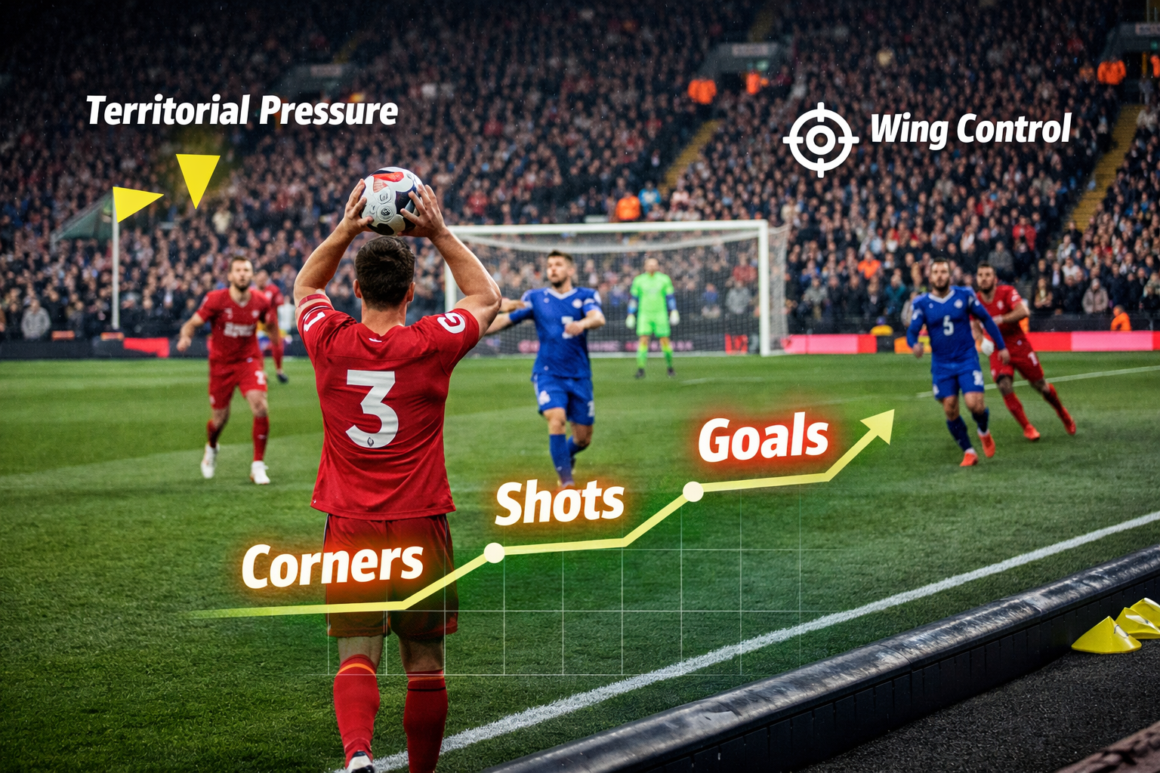
The throw-in is football’s wallflower. It’s there at every match, constantly present, but almost nobody pays attention to it. Fans clap for goals, scream at penalties, argue about offsides. Meanwhile, somewhere along the touchline, a player quietly lifts the ball over his head and tosses it back into play. No fireworks. No replays. Just a routine restart.

But here’s the strange thing: throw-ins might be one of the most underrated indicators of match momentum.
Yes, really.
Behind that ordinary two-handed toss hides a small piece of tactical data that can reveal which team is slowly tightening the screws. If you watch carefully—or better yet, if you track the numbers—you’ll notice patterns that appear just before corners, shots, and sometimes even goals.
Let’s talk about why throw-ins deserve a little more respect.

The Hidden Data Angle for Bettors
In the era of live statistics, bettors are always looking for small edges—little clues hidden in the flow of the match.
Goals, shots, and corners are obvious. Everyone tracks them.
Throw-ins? Almost nobody does.
That’s precisely what makes them interesting.
Imagine you’re watching a match where the statistics look calm. No shots yet. Possession is fairly even. The scoreboard reads 0-0.
But the throw-in count suddenly looks like this in the last five minutes:
Team A: 6 throw-ins in attacking areas
Team B: 1 throw-in in midfield
The ball keeps bouncing out near Team B’s defensive flank. Each restart pulls the defensive line deeper.
That’s not just random noise. That’s territorial pressure building quietly.
These minor changes are sometimes sought by smart bettors when they engage in live football betting and have a chance of winning which involves momentum shifts that will provide a small opening before odds are adjusted. Betting websites such as 22Bet, among others, offer dynamic real-time markets where gamblers can respond immediately to the dynamic of the match. Once a team starts to accumulate attacking throw-ins, it may indicate that corners, or shots, or even dangerous attacks would follow soon. It is not sorcery or even foolproof, but to those who follow the rhythm of the game instead of the score board, such moments can be used to tell where the match is heading to next.
The Geography of Pressure
A football pitch is basically a map of territorial control. One team tries to push the game higher up the field. The other tries to resist or counter.
Throw-ins are like little GPS markers that tell you where the battle is happening.
If Team A keeps forcing the ball out of play near Team B’s defensive third, something is happening. It means:
The attacking team is pressing the wings.
Defenders are scrambling and clearing under pressure.
Possession is being recycled again and again in dangerous areas.
One throw-in might mean nothing. But five throw-ins in two minutes near the opponent’s box? That starts to feel different.
Momentum, in football, rarely arrives like lightning. More often it creeps in quietly. A series of throw-ins. Then a corner. Then a blocked shot. Suddenly the stadium feels tense.
Throw-ins are often the first breadcrumb in that trail.
The Wing Control Indicator
Most throw-ins occur along the sidelines, which means they are directly tied to wing play. And modern football loves the wings.
Think of teams like Liverpool during their peak pressing years or Manchester City during their positional-play dominance. Their attacks constantly recycle through wide areas. The ball goes to the winger, overlaps with a full-back, gets blocked, goes out for a throw-in… and the pressure continues.
That repetition is important.
When a team repeatedly earns throw-ins high up the pitch, it often signals three tactical realities:
The attacking side is dominating wide spaces. The defending side is clearing under stress. Possession is staying in the same zone.
It’s like watching waves crash against a seawall. Each one looks harmless. But the repetition tells you something bigger is building.
Analysts sometimes call this territorial pressure. And throw-ins help measure it in real time.
When Throw-Ins Become Momentum
Now comes the interesting part.
Some match analysts have started noticing that clusters of throw-ins often precede attacking events. Not always, of course—football is far too chaotic for perfect prediction—but the patterns are intriguing.
Consider a typical sequence:
Winger drives down the flank
Defender blocks the cross → throw-in
Attacking team quickly restarts
Another challenge → another throw-in
Ball recycled again into the box
Two minutes later: corner kick.
Thirty seconds after that: shot on goal.
If you scroll through event data in some matches, you can actually see these micro-storms of possession forming along the wings before the bigger attacking moments appear.
For bettors and analysts, this is fascinating because it suggests something subtle: throw-in streaks may act as an early signal of attacking pressure.
Not a guarantee. But a signal.
The Set-Piece Specialists
The other twist of this story.
There are even teams who have made throw-ins to a real tactical weapon.
You may recollect how a few years ago Liverpool engaged a throw-in coach,–a step which left people a-laughing. But the concept was straightforward: the less often a team gives up the ball on the throw-in the more it can maintain pressure.
And constant pressure is precisely the cause of:
More shots
More corners
Younger more anarchy, in the penalty box.
A good throw-in may restart an attack immediately and the defenders are caught before they can rearrange themselves.
So when a team players win several throw-ins, close to the corner flag of the opponent, it is not only a restart of the game. It is making the defense restart all over.
It is likely to be followed by fatigue and mistakes.
The Reading of the Game Between the Lines
Football has never been anything but a game of details. The greatest hints are sometimes the tiniest little things.
A wing back kicking his opponent.
A shot ricocating off a shin.
A ball rolling somewhere out by the corner flag.
The stadium barely reacts. The commentator hardly says anything about it.
However, analysts, and more and more astute punters, are starting to take these moments in a new way.
Throw-ins are not glamorous. They will not produce highlight films. None of the children dream of making a perfect throw-in.
But in the silent way they show us something fundamental about the movement of a match; who is pressing, who is defending, and where the pressure is accumulating.
In a match that is won by margins such clues are important.
Then next time you are watching a game, take your eyes off the score board. Watch the sidelines instead.
Count the throw-ins.
When one side begins picking them like lost coins in front of the opponent box, then you may be seeing the first stirring of a greater thing. And the rumble is often preceded by the thunder in football.